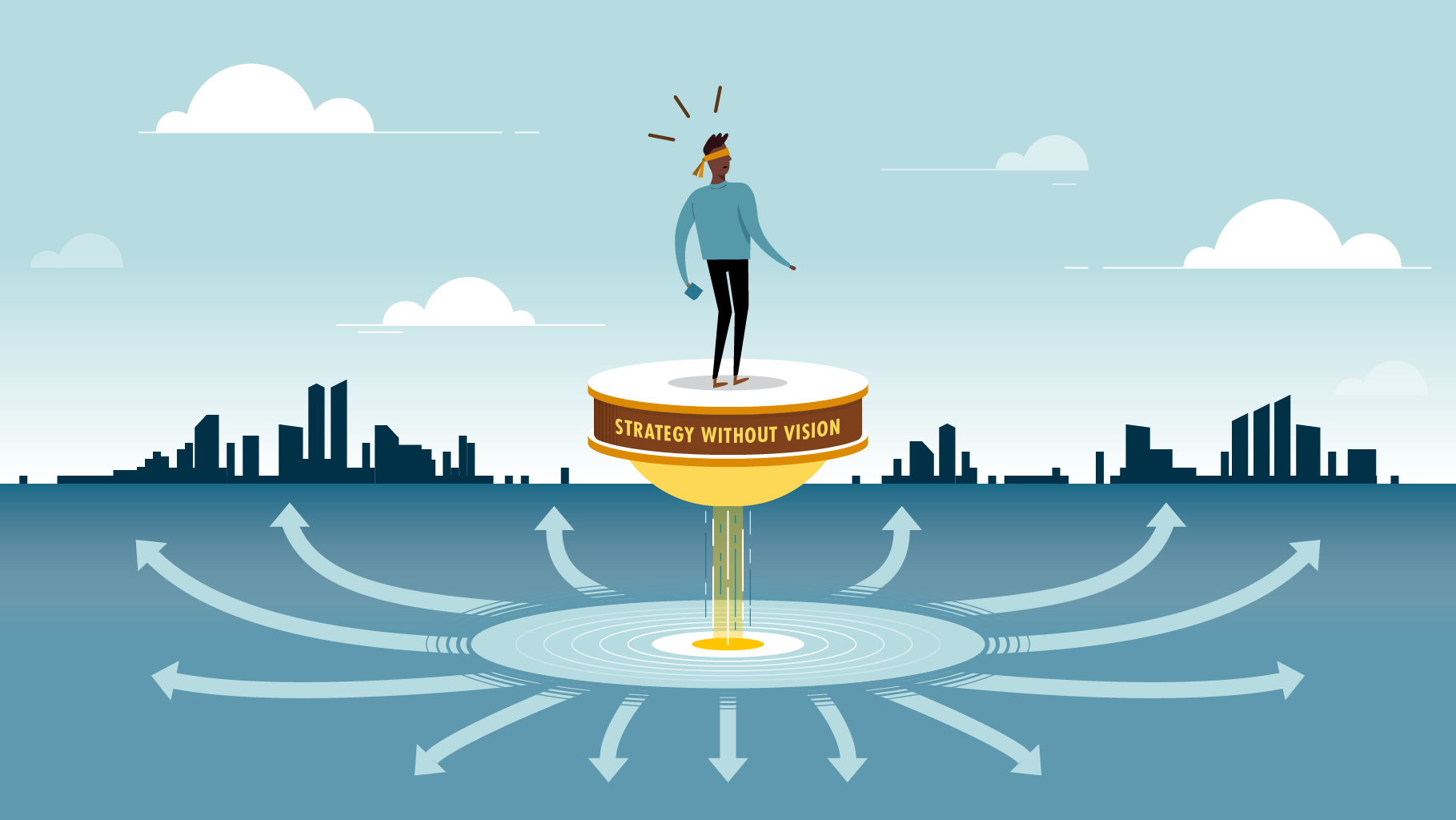
For decades, leaders have created confidence during transformation by giving people a roadmap: Here’s where we’re going. Here’s how we’ll get there. Here’s what happens next. But what happens when the ground keeps shifting, making the path impossible to route?
Organizational transformation is no longer about managing discrete change initiatives. Today’s transformation efforts are increasingly emergent. Advancing technology, market disruptions, evolving customer and workforce expectations are arriving faster and from multiple directions at once. Leaders may have a clear sense of the business outcomes they need to achieve, but the path to get there can change before the organization has finished executing the plan.
That doesn’t mean planning is obsolete. It means leaders can no longer rely on the roadmap as their primary source of clarity.
In fact, when you can’t give people certainty about the path, it becomes even more important to give them clarity about what they’re moving toward.
That’s where the vision—and particularly the visual articulation of the vision and strategy—take on new importance.
The less certain the path, the more important the clarity about the destination becomes.
Vision alone, however, isn’t enough. People may understand and even feel inspired by the future the organization wants to create without knowing what that means for the decisions they need to make today. This is where strategy articulation becomes critical. We think of vision, strategy, and operational planning as interconnected layers of clarity:
- Vision provides the big-picture story and long-term direction.
It answers: What future are we trying to create?
- Strategy articulates the choices and priorities that will move us toward it.
It answers: Given what we know today, what matters most, what are the choices, priorities, and trade-offs we need to make to move the organization toward the vision?
- Operational planning translates those priorities into near-term execution.
It answers: What will we do now, and who will do it?
In a predictable environment, organizations could place considerable confidence in the operational plan. Build the roadmap, assign accountability, execute, and measure progress. Emergent transformation changes that equation. As conditions evolve, operational plans need to change. Strategic choices may need to be revisited. The organization needs to respond to new signals without interpreting every change in direction as a new destination.
A clear vision creates the coherence that allows the other layers to flex.
Vision provides direction. Strategy turns it into choices.
Traditionally, vision has been treated as the starting point of strategic planning: define the desired future, build a strategy to achieve it, and translate that strategy into a roadmap for execution. That basic relationship still matters. What’s changing is how leaders need to think about each component.
In emergent transformation, vision isn’t a destination painted in perfect detail. It’s a shared point of orientation that allows people to navigate uncertainty and choose the next best step as conditions change.
Think of the difference between a roadmap and a compass. A roadmap is incredibly useful when the roads remain where you expect them to be. But when conditions change, routes close, or entirely new terrain emerges following the original map more precisely won’t necessarily get you where you need to go. You need something that keeps you oriented.
A compelling vision is that compass for an organization. It creates a shared understanding of the future you are working to create, so when new information arrives, or circumstances shift, people can re-orient themselves by asking: Given what we know now, what decision will move us closer to that future?
This makes vision much more than an inspirational statement. It becomes a filter for decision-making—and an anchor for adaptation.
In an environment of continuous change, leaders simply can’t prescribe every action people should take. New information emerges too quickly. Customer needs change. Technology creates new possibilities. Teams encounter realities that senior leaders may not see from where they sit.
People closer to the work need enough clarity to exercise judgment and adapt.
Visualizing sharpens the strategy.
Emergent transformation asks something different of leaders. When the job is no longer to predict every turn in the road, the job becomes about creating the conditions that allow people to keep moving forward as circumstances change. That requires both adaptability and clarity.
Of course, having a vision and strategy is one thing. Having a shared understanding of what they mean is another.
Words like innovative, customer-centric, agile, or AI-enabled can create the illusion of alignment. A leadership team may readily agree that it wants to become a more innovative organization. But ask each leader to describe what “innovative” actually looks like—in how people work, make decisions, interact with customers, or allocate resources—and very different pictures emerge.
This is where visual articulation is the most powerful.

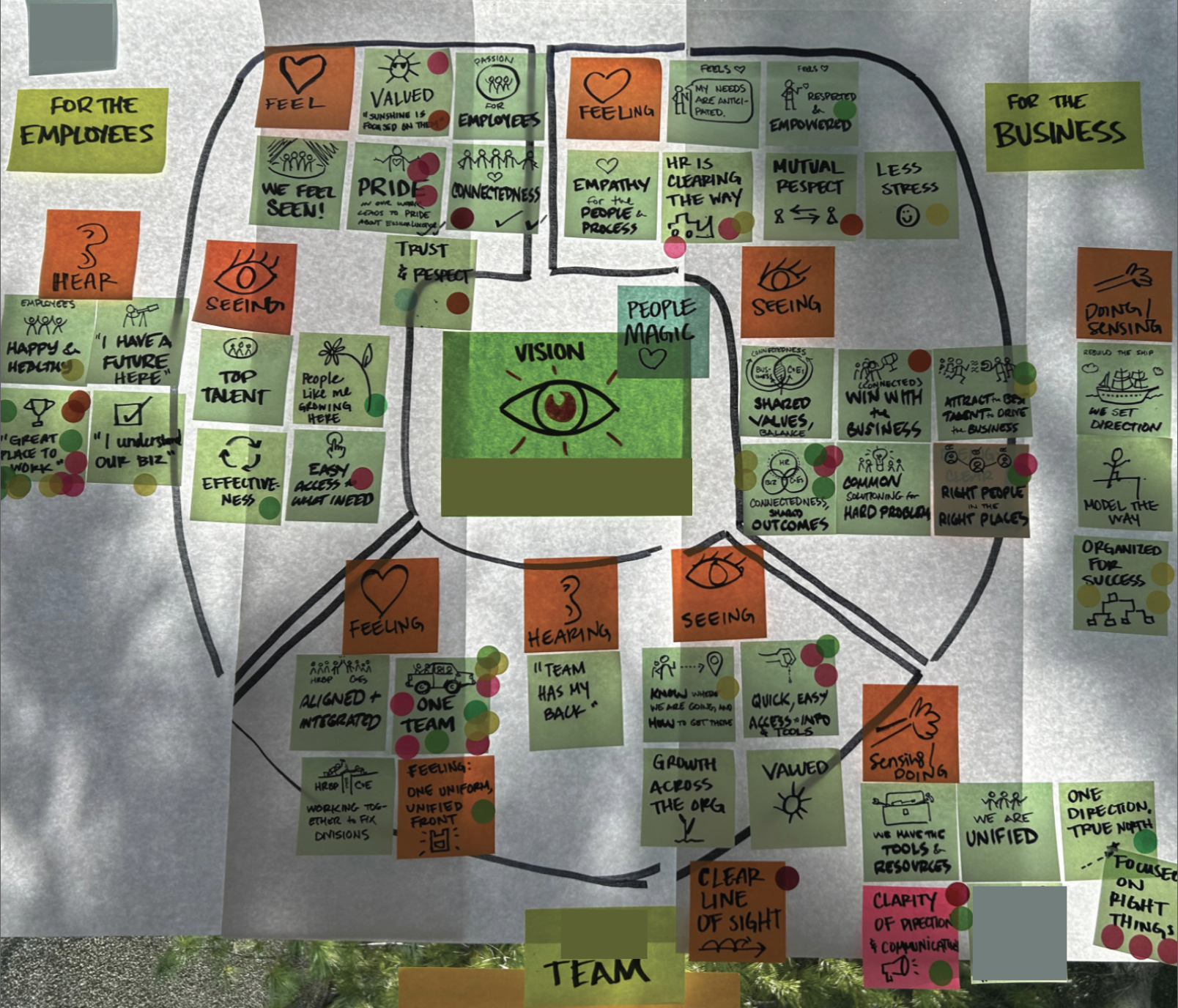
When leaders are asked to make their vision and strategy visible, abstract language has to become concrete. They have to wrestle with questions like: What do we really mean? What would be different? What would people see and experience? What matters most? How do these ideas connect?
The process surfaces assumptions and differences in interpretation that words alone can conceal. It pushes leaders to define ambiguous ideas, see relationships between choices, prioritize what matters most, and align around a shared story of the future. It’s how we define the meaning behind the aspirations.
And the value doesn’t end when the picture is finished. A well-articulated visual gives the broader organization a common reference point for conversation, decision-making, and action. Instead of asking people to interpret pages of strategy independently, it gives them a shared picture they can return to as conditions change: This is what we’re moving toward. This is what matters. How does what we know now, shape what we do next?
That distinction is particularly important during emergent transformation. Your strategy will evolve. Your operational plans will change. The path may look different six months from now than it does today. A shared visual creates coherence through that movement—helping people adapt without losing sight of what the organization is trying to become.
Visualizing your vision and strategy, then, isn’t simply about creating an artifact after the strategic thinking is complete. Creating it is part of the strategic thinking. Using it is part of the transformation.
When you can’t map every turn, make the destination visible.