This post was first published in 2020 and has been updated in July 2025 with fresh content and the latest information.

Shifts in technology, market uncertainty, and social-political curveballs are rewriting the rules in real time. And if the last few years have taught us anything, it’s that long-term plans can become irrelevant overnight. That’s why resilience isn’t just a buzzword—it’s a leadership essential. 

A resilience plan helps you respond to the unexpected with clarity and focus, so you’re not just reacting—you’re adapting with intention. It’s a practical way to steady your team, set priorities, and move forward even when the path ahead is unclear.

Elements of a Resilience Plan

A resilience plan bridges the gap between the immediate crisis and longer-term strategy. A resilience plan consists of three key elements:

  • set of scenarios about what might be ahead and actions to take in each case.
  • set of near-term priorities and decisions about what needs to be set aside.
  • A way to manage prioritized initiatives until we arrive at a new normal.

Preparing for Resilience Planning

Before creating a resilience plan, you need to assess the current situation through three lenses.

Lens #1: Outcomes of Change

First, you need to understand the new context and the four likely outcomes that organizations might experience as a result of the change.

Go faster. Respond to accelerated growth at maximum speed, effort, and risk. For instance, if there is a rising demand for your product or service.

Pump the brakes. Respond to a foreseeable decline in revenue and a need to conserve resources. For example, if there’s a surge in costs or limited access to resources.

Stop the car. Respond to major shifts in strategy to ensure sustainability in the face of adversity. If emerging forces threaten to make your product or service obsolete.

Break the glass. Respond to an existential crisis that requires a major retooling for survival. In the event that circumstances beyond your control threaten the market or your industry overall.

Depending on your industry and the circumstances, you will need to develop a different set of scenarios to help guide your response and lead your organization.

Lens #2: The Long View

While we can’t predict how each crisis might play out, we can prepare for the four phases on the route to full recovery.

Phase 1—Crisis. During the initial crisis, there might be a growing sense of fear as daily life is disrupted. Chaos, confusion, and a need for immediate defensive action may consume your attention. 

Phase 2—Recession. In this phase, there may be a real dip ahead and organizations may need to brace for the realities of recession. During this time, company cultures are deeply impacted by the decisions made and how they are made. Organizations need to examine their values, make hard decisions, reprioritize, and plan contingencies to weather the storm. 

Phase 3—New normal. As situations stabilize, adjustments to the organizational structure now match the new market reality, and teams are beginning to set new ways of working. This is the point when we can start to shift from a resilience plan to a longer-term strategy once more.

Phase 4—Recovery. With a new reality and a redefined context, organizations move into full recovery. Longer-term strategic plans become relevant once more. This is the time to examine strategies through the lens of the new context. How has the new normal shifted or changed our new business reality? How do we have to adapt our strategy to fit the new reality?

Organizations that build their near-term resilience plan with the long view in mind are likely to make much better decisions in the weeks ahead. They will plan for sustainability today but preserve resources for faster recovery tomorrow.

Lens #3: Implications

Keep in mind that the new normal is not all negative. New opportunities are created, new technologies emerge, along with new ways of working and new connections forged. With this in mind, consider:

  • “Wait and see” won’t work. Today’s challenges demand agility, clarity, and above all, resilience. We cannot simply wait for it to blow over.
  • Plan faster and with more agility. Structure with increased fluidity, fast-moving change demands flexible and adaptable plans. 
  • The new normal might not be like anything we’ve known before. We are being thrust into new realities. We may need to rethink new possibilities and be open to long-term disruption.

Creating a Resilience Plan

How do we take practical steps to create a resilience plan for our organizations? First, remember that you do not need to throw away your strategy—you just need to change your route in the near term. Second, determine your immediate needs to manage your organization through this crisis, and look for opportunities to accelerate your path to recovery tomorrow.

The Elements

At XPLANE, we build resilience plans through workshops consisting of exercises that help you and your team(s) identify scenarios, prioritize activities, and take action. Here’s an overview.

The Agenda

  • Goals and objectives
  • Check-in with the team: What clarity do you hope to walk out of this meeting with today?
  • Scenario Planning: Four Views Scenario Planning exercise
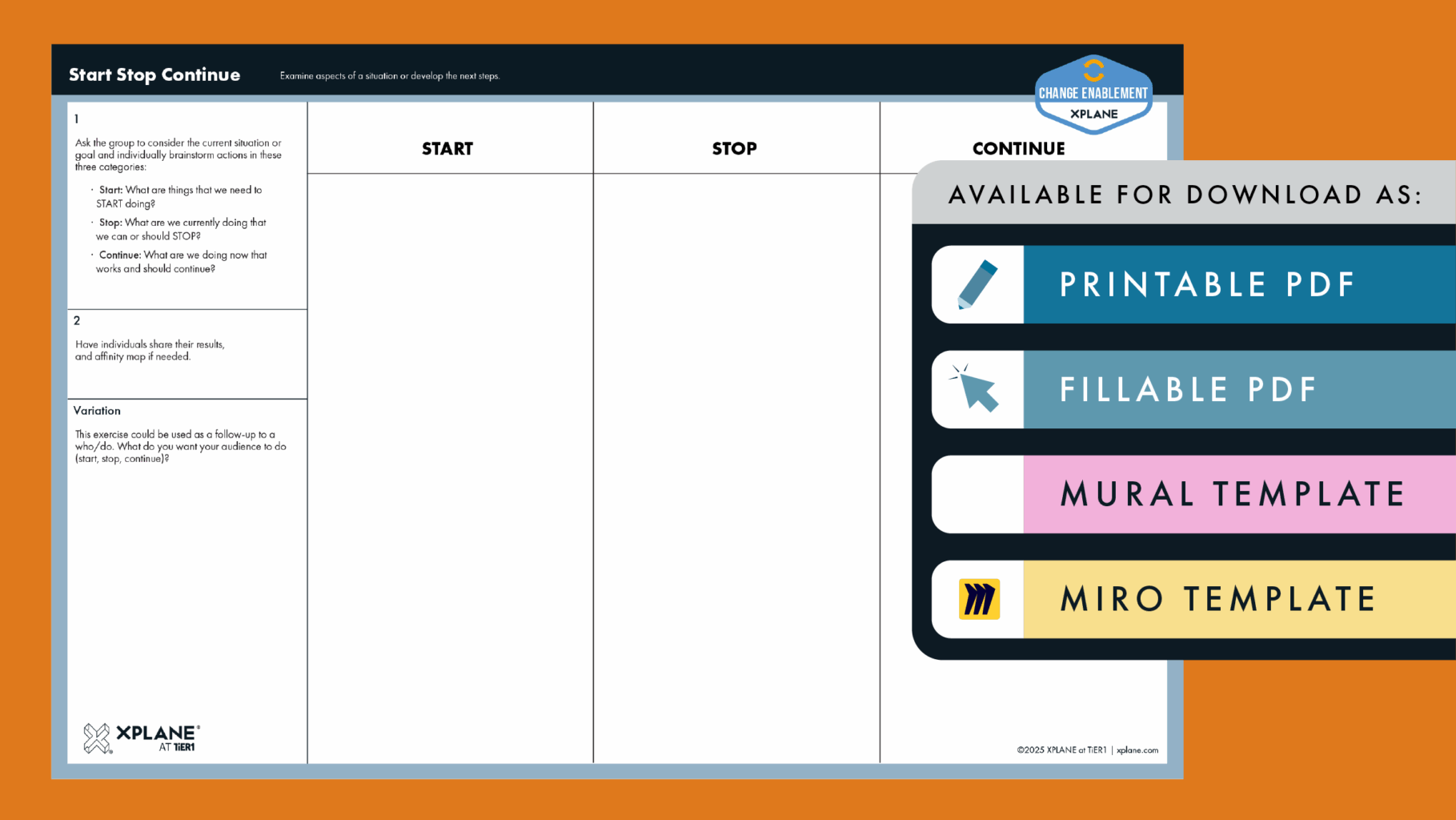
  • Prioritization: Start/Stop/Continue exercise
  • Road-mapping: 30/60/90 exercise
  • Action Planning: Initiative Planning exercise
  • Readout and Refine
  • Governance and Next Steps

This sample agenda is designed for a two-hour workshop, broken into 20-minute modules that can be adjusted up or down as needed.

Each module consists of a discrete, collaborative exercise with a clear purpose. Because all voices need to be heard, we recommend you use the first 20 minutes of your workshop to set this expectation. Resilience planning requires broad representation and buy-in, so we recommend that attendees represent key functions within your organization.

The Four Views Scenario Planning exercise helps teams consider the long view and accelerate decision-making by anticipating possible situations and proactively thinking about possible responses to each.

Prioritization is essential because crisis require us to ruthlessly triage efforts. The Start, Stop, Continue Exercise exercise helps teams understand what they need to do and what they need to stop doing to move forward. Remember that stop doesn’t necessarily mean stop forever. A good guideline is to add as much to the stop bucket as you have in the start bucket. 

Next, assemble priorities using the 30/60/90 exercise to create a roadmap that shows the order in which you’ll execute efforts. While most of us are accustomed to planning in quarters or years, for crisis or resilience planning, we’re looking at near-term efforts based on the crisis scenario. Refine your road map by asking: (1) Are the due dates realistic? (2) What dependencies exist between each effort and how might that adjust the scheduling? (3) What’s missing?

You now have a draft roadmap to carry forward into action planning. Some efforts may be existing initiatives that are already assigned, many others will be be new. You’ll need to add detail, build these into your action plan, and assign each activity to an individual or team. Use the Initiative Tracker to assign and track work on an ongoing basis. 

Be Ready for Change

A resilience plan will help your organization better move through crisis into recovery. By making difficult decisions today and keeping an eye toward the future, you will know what to protect in terms of people, resources, capabilities, and culture to rise again with strength tomorrow.